



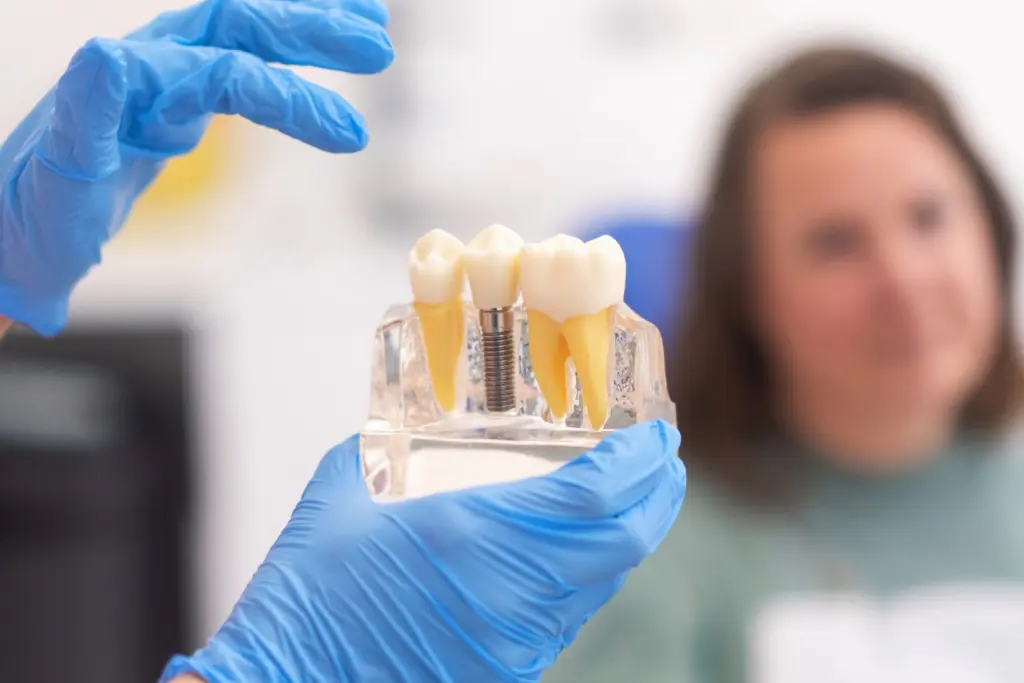
Implants | |
Dental implant Consultation | £80 |
Dental implant placement | £1,800 |
Crown – Zirconium | £900 |
Full upper arch (Denture on 4 implants) | from £6900 |
Full lower arch (Denture on 2 implants) | from £4200 |
All in 4 | £9800 |
All in 6 | £13400 |
| £500 |
| from £4200 |

A dental implant consultation that includes a CBCT (Cone Beam Computed Tomography) scan.
Here’s what you can expect during the consultation:
Initial Discussion:
Your dentist will discuss your goals for the treatment (e.g., improved chewing, smile aesthetics, replacing missing teeth).
They’ll review your dental and medical history, including any relevant conditions or medications, as this can affect implant success.
Oral Examination:
A thorough examination of your mouth, teeth, and gums will be conducted to check for any signs of infection or bone loss.
CBCT Scan:
A Cone Beam CT scan will be taken to create highly detailed 3D images of your teeth, jawbone, nerves, and surrounding structures.
This provides a comprehensive view for assessing bone density and volume, identifying critical anatomical structures like nerves and sinuses, and ensuring safe implant placement.
The scan itself is typically quick, painless, and non-invasive, lasting only a few minutes.
Treatment Planning:
Based on the examination and CBCT scan results, the dentist will create a personalized treatment plan.
This may involve discussing any necessary preparatory procedures, such as bone grafting or sinus lifts, to ensure adequate bone support for the implant.
The plan will include details about the type of implant, its optimal placement location, depth, and angle.
Discussion of Costs and Timeline:
Your dentist will provide a detailed breakdown of the cost of the implant procedure, including any additional fees for preparatory procedures.
They may also discuss financing options.
A timeline for the entire implant process, including follow-up visits and the healing period, will be discussed.
Addressing Your Questions about Implants:
You’ll have the opportunity to ask any questions or voice concerns you may have about the implant procedure.
Benefits of a CBCT Scan for Implant Planning:
Detailed 3D View: Provides a comprehensive 3D view of your jawbone, allowing for accurate assessment of bone density and volume.
Enhanced Precision: Helps pinpoint the ideal location, depth, and angle for implant placement, leading to improved precision and success.
Identification of Critical Structures: Helps visualize vital anatomical structures like nerves and sinuses, ensuring safe placement and reducing the risk of complications.
Reduced Risk of Complications: Minimizes risks such as implant failure, nerve damage, or improper positioning.
Improved Patient Experience: Allows patients to see what’s happening and understand the implant process more clearly.
Is a CBCT scan always necessary for dental implants?
While not technically always necessary, a CBCT scan is considered the standard of care for dental implant planning and procedures. It provides crucial information for accurate diagnosis and successful implant placement, especially in complex cases or when dealing with potential complications.
In summary, a dental implant consultation with a CBCT scan provides a detailed roadmap for your implant journey, ensuring a safe, precise, and predictable treatment process.